• Link to Facebook
  • Link to X
  • Link to LinkedIn
  • Link to Youtube
  • Careers
  • Provider Search
  • Patient Portal
  • Pay My Bill
AZ Medical Group
  • About DMG
    • Board of Directors
    • Corporate Leadership Team
    • Provider Leadership Team
    • Operations Leadership Team
    • Community Involvement
    • Research
    • Careers at DMG
    • FAQ
    • Annual Report
  • Medical Specialties
      • Anesthesiology/Pain Management
      • Audiology
      • Behavioral Health
      • Burn Treatment
      • Cardiology
      • Dermatology
      • Ears, Nose and Throat
      • Emergency Medicine/Critical Care
      • Endocrinology/Diabetes
      • Eye Health
      • Family Medicine
      • Gastroenterology
      • Hematology and Oncology
      • Infectious Disease and HIV
      • Internal Medicine
      • Nephrology/Kidney Disease
      • Neurology/Neurosurgery
      • Orthopedics/Sports Medicine
      • Pathology
      • Pediatrics and Pediatric Specialties
      • Physical Medicine and Rehabilitation
      • Podiatry
      • Primary Care
      • Pulmonology/Respiratory
      • Radiology
      • Rheumatology
      • Surgical Specialties
      • Urology
      • Women’s Health
  • Locations
    • Behavioral Health
      • Emotional, mental and psychiatric
        health services

      • Valleywise Behavioral Health Centers:
      • Maryvale
      • Mesa
      • Phoenix
    • Community Health
      • Primary care, counseling, women’s health,
        pharmacy, radiology

      • Valleywise Community Health Centers:
      • Avondale
      • Chandler
      • Guadalupe
      • McDowell
      • Mesa
      • North Phoenix
      • South Central Phoenix
      • South Phoenix/Laveen
      • West Maryvale
    • Comprehensive Health
      • Primary care, medical specialists,
        radiology, pharmacy

      • Valleywise Comprehensive Health Centers:
      • Peoria
      • Phoenix
  • Blogs and News
    • A Provider’s Perspective

      • Your Family’s Health
      • Your Child’s Health
      • Women’s Health
      • Men’s Health
    • Other DMG News

      • DMG Press Releases and Updates
      • DMG in the News
  • Medical Education
    • Creighton University AZ Health Education Alliance
    • Residencies and Fellowships
    • Undergraduate Programs
    • Allied Health Professionals
  • Contact Us
    • Appointments
    • Careers
    • FAQ
  • Quicklinks
    • For Patients and Visitors

      • Medical Specialties
      • Patient Portal
      • Appointments
      • Provider Search
      • Pay My Bill
      • FAQ
      • Locations and Directions
      • Notice of Non-Discrimination
    • For Medical Providers

      • Medical Specialties
      • Medical Research Publications
      • Medical Education Programs
    • Careers

      • Working at DMG
      • Administrative Job Listings
      • Provider Job Listings
  • Click to open the search input field Search
  • Menu Menu
You are here: Home1 / A Provider’s Perspective2 / Providers Perspective3 / How to Protect Your Family from a Measles Outbreak

How to Protect Your Family from a Measles Outbreak

By Troy Nelson, MD, medical director and pediatrician

March 21, 2025/District Medical Group
  • Young family spending time

Measles cases in the US 2025

As of March 6, 2025, the United States has had three measles outbreaks and a total of 222 cases across 12 states- a significant increase when compared to 2024. In the entire year of 2024, 285 measles cases were reported across the United States, with some of those cases being in Arizona, according to the Centers for Disease Control and Prevention (CDC).

We’re not alone. Globally, measles activity is also increasing.

Why are more people getting the measles?

In 2000, the United States declared measles as “eliminated” due to the extremely high percentage of Americans receiving the measles, mumps and rubella (MMR) vaccine. The target rate for MMR vaccinations is 95% coverage among children entering kindergarten.

So, why are we seeing measles outbreaks now and why are the number of cases increasing annually? According to the CDC, the two primary reasons are:

  • MMR vaccination coverage among U.S. kindergarteners is below the target rate of 95% and decreasing each year.
  • Global measles activity is increasing, enabling an unvaccinated U.S. citizen traveling abroad to bring it back to our country after international travel.

Declining vaccination rates

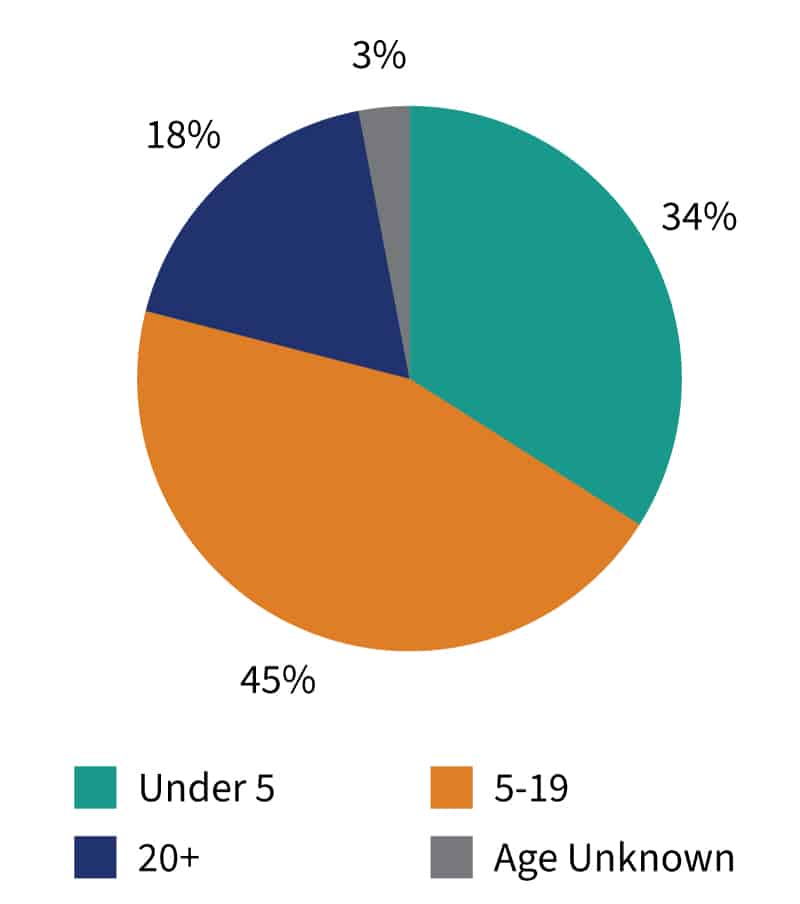
Among the 222 measles cases reported in the U.S. as of March 6, 2025, 94% of the people were unvaccinated. 17% of those diagnosed with measles were hospitalized and two measles-related deaths have been reported according to the CDC.

Of the 38 total hospitalizations, 32 were children aged 19 and under. While tragic, this data is not surprising. As previously stated, MMR vaccination rates among school-aged children have been declining consistently since 2020- after 10 years of 95% nationwide vaccination coverage of MMR and other childhood vaccinations.

75% of states are below the target 95% childhood vaccination rate for children entering school. Arizona is one of them with a vaccination rate of 89.3%. The epicenter of the most recent measles outbreak, Gaines County in West Texas, has a vaccination rate of 82%.

Recently reported by azfamily.com, the most current data from Arizona Department of Health Services surfaces four counties in Arizona that have vaccination rates lower than Gaines County, Texas:

  • Gila County: 79.9%
  • Navajo County: 79.7%
  • Mohave County: 76%
  • Yavapai County: 75.2%

Santa Cruz and Yuma Counties have the highest vaccination rates, both of which are above the targeted 95%. Here in Maricopa County, which has the largest population of Arizonans, our vaccination rate is below the targeted 95%.

What you need to know about the MMR vaccine

The MMR vaccine is a proven safe vaccine that when administered as directed has a 97% effective rate in protecting an individual from measles, mumps and rubella (MMR). The vaccine does have some potential short term side effects, including:

  • Fever: One in six individuals who get the MMR vaccine develop a fever 7-12 days after receiving the vaccine.
  • Febrile seizures (rare): One in 3000 individuals develop febrile seizures, which are generally harmless and resolve on their own with no long term effects. Most common in children between the ages of six months and five years and accompanied by a fever, this type of seizure lasts no more than five minutes.
    • For more information on febrile seizures, visit the National Institute of Neurological Disorders and Stroke.

The American Academy of Family Physicians, American Academy of Pediatrics and CDC all recommend two doses of the MMR vaccine. Children should receive the first dose at age 12-15 months and the second dost at four to six years of age before entering school.

It’s not too late to get the MMR vaccine. If you or your school-aged child did not get the MMR vaccine, regardless of current age, the MMR vaccine is recommended. Consult your primary care provider to ensure your family is protected from measles.

Should a child with a chronic condition or disease be vaccinated?

We understand that as a parent, you may have questions and concerns about what vaccinations are appropriate for your child and when, especially if your child has a complex condition like spina bifida, a genetic disorder or heart condition. We always recommend you consult with your child’s pediatrician or primary care provider about when and what vaccinations your child needs. Having a pediatrician or primary care provider who regularly sees your child and is aware of all their health conditions is critical in ensuring your child is protected from measles and other diseases as best as possible.


Share this entry
  • Share on Facebook
  • Share on X
  • Share on WhatsApp
  • Share on Pinterest
  • Share on LinkedIn
  • Share by Mail

News Feeds

  • A Provider’s Perspective
    • Your Family’s Health
    • Your Child’s Health
    • Women’s Health
    • Men’s Health
  • Press Releases and Updates
  • DMG in the News
schedule an appointment

Most Recent

  • What is Psoriasis? July 24, 2026
  • Helix Laser with Dr. Jain of Valleywise Health June 29, 2026
  • What You Need to Know about the Newest Approved Sunscreen Ingredient June 25, 2026
  • What is the Difference between a Migraine and a Headache? June 11, 2026
  • Common Myths about PTSD June 11, 2026
  • How to Protect Yourself from Osteoporosis April 20, 2026
  • Why Can’t I Sleep? April 20, 2026
  • DMG Physicians’ Life-saving Efforts Recognized by Phoenix Fire Department April 16, 2026
  • What You Need to Know about Sexually Transmitted Infections April 9, 2026
  • Why the Health of Your Feet Matters April 7, 2026

DMG Corporate

2929 E. Thomas Rd.
Phoenix, AZ 85016
Phone: (602) 470-5000
Fax: (602) 470-5063
  • Link to Facebook
  • Link to X
  • Link to LinkedIn
  • Link to Youtube

Patient Billing Rights

  • No Surprise Billing Act
  • Notice of Disclosure
  • Good Faith Estimate or Cost Estimates
  • Facturas Médicas Sorpresa

Patient Rights and Privacy

  • Notice of Non-Discrimination
  • Notice of Compliance for
    Patient Electronic Access
  • Notice of Privacy Practices

Quick Links

  • Medical Specialties
  • DMG Provider Locations
  • Appointments
  • Pay My Bill
  • About DMG
  • Medical Education
  • Careers
  • Contact

DMG Employee Resources

  • DMG IT Service Desk
  • DMG Email Access
  • DMG eLearning System Access
  • United Healthcare’s Transparency in Coverage
  • Additional Resources

Leadership Access

  • DMG Board Portal
© District Medical Group - A non-profit Phoenix medical group since 1993
  • Link to Facebook
  • Link to X
  • Link to LinkedIn
  • Link to Youtube
  • Privacy Policy
  • Web Design Phoenix
Link to: Valleywise Health, Black History Month – Dr. Mosley Valleywise Health, Black History Month – Dr. MosleyVH Black History - Dr. Mosley Link to: What Causes Bed Wetting in Children? What causes bed-wetting in childrenWhat Causes Bed Wetting in Children?
Scroll to top Scroll to top